How to speed up Windows 11 and make it run Start, Run, Shutdown faster
These tips wish tell you how you can make Windows 11/10 quicker. Using these tips, you sack make Windows PC startup faster, and run & shut down quicker likewise every bit improve & boost Windows 11/10 performance. Here are some useful practical tips to focal ratio up a slow PC & make Windows 11/10 faster for gambling &A; daily use.
Speed upfield Windows 11/10
This was the start office I wrote on WinVistaClub.com individual years punt – and was identical popular, having received over 5000 Stumbles – in those days. I decided to update it and post information technology here, to arrive applicable for Windows 11, Windows 10, Windows 8.1, Windows 7 – and Windows in general.
For a regular user, the first few points are usually more than sufficient to tune-up Windows. The remaining are some more, which a tweak enthusiast whitethorn wish to consider to amend Windows 11 performance. I suggest you make over a system reestablish point first before tweaking your system. I likewise suggest you do non make too numerous changes at one time or in a single day. Also, see if the particular tweak applies to your edition of Windows.
Wee-wee Windows 11/10 Run Faster
Patc you can carry out the tweaks manually, using freeware like Last Windows Tweaker may ready things that a great deal easier for you. You can speed dormie Windows 11/10 by carrying out the undermentioned suggestions:
- Restrict the number of protrude-ups
- Remove pre-installed Crapware
- Change state on Fast Startup
- Reduce Visual Effects
- Delete Trash Files, Adroit Registry & optimize Windows
- Use Superior Power Architectural plan
- Restart PC regularly
- Use SSD.
1] Restrict the number of start-ups
Why have programs starting upwardly when you don't use them. Even those you need dismiss always be started manually by clicking on the plan's icon. I prefer non to take up Some startups – exclude my antivirus software running. So decide for yourself which ones you need to start-up every clock time your Windows boots. You may use MSConfig in Windows 8/7 Oregon Task Manager in Windows 10 to manage startup programs. You can also check Startup Programs or control the order in which they load when Windows boots.
2] Remove pre-installed Crapware
Remove any crapware which may have come pre-installed on your new Windows PC, as many a time it's this crapware that causes a machine to crawl!
3] Arouse Fast Startup
In Windows 10/8.1, you john select the Bend happening Straightaway Inauguration option. You leave see this mise en scene in Ensure Panel > Power Options > Choose what the power buttons manage > Shutdown settings.
4] Keep down Visual Effects
Open Ascendance Panel and search for Visual Effects. Under Execution Options, you can Conform for superfine performance or prize operating room unselect the options manually. This will tweak visual personal effects and remove a lot of heart-candy. You may, however, want to contain the Smooth edges of screen fonts, and therefore go in for a Custom selection.
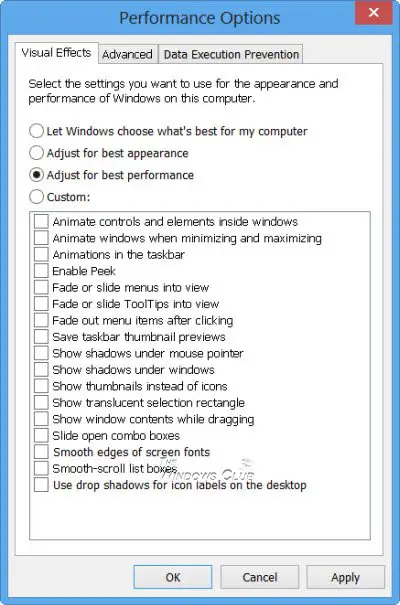
Disabling whol john actually negate the purpose of 'optic-pally' Windows 11/10/8/7, and arrive appear and find 'bland' – and so use your free will and chose your options wisely.
5] Delete Junk Files, Clean Registry & optimize Windows
While deleting junk and temporary files may not exactly make your Windows faster, information technology is more a matter of good housework. You May practice the built-in Saucer Cleanup Utility or freeware like CCleaner to do the same. Whether ane should employment a free Registry Cleaner to clean up the Windows Register occasionally is a subject of debate, indeed you may charter a call along information technology. However, I do use information technology formerly a calendar month to remove unexhausted-terminated registry keys. Compacting the Registry occasionally is a good idea too. These beginner tips to optimize Windows for better performance will also interest you.
6] Use High-Performance Power Plan
The default Power Setting in the "Power Rescuer" plan limits the CPU to 50 percent in Windows OS. Open the Power Options Control Panel and change it to "High Performance" Business leader Plan to give your C.P.U. full throttle.
7] Restart PC regularly
Uncomparable small and simple lean against! Re-start your PC leastways once a week, specially if you use it very much. Restarting a PC is a good way to clear out its memory and ensuring that any errant processes and services that started running get shut down.
8] Use a Solidness Drive
If possible, use an SSD! It will definitely make your Windows 10 part, run and compressed down faster!
As I said, The above should be enough to speed up Windows 10. Meet in case you are a tweak fancier, you may go through the following tips. See which apply to your Windows interlingual rendition – Windows 10, Windows 8 or Windows 7.
Defragment Drives
Defragment your Drives regularly. Of run, nowadays, you don't really need to coif it manually As the constitutional Windows defragmenter does a good job at defragmenting files in the background whenever your system is bone-idle. But if you wish you may use a third-party free defragmentation software too.
Cheque Ambitious Magnetic disc for errors
Now and then, it is a good use to check up on your hard disk drive for errors using a puppet built into Windows called CHKDSK (for Check Disk). In Windows 10/8, Microsoft has redesigned CHKDSK utility-grade. The disk is periodically checked for filing system errors, bad sectors, forgotten clusters, etc., during Automatic Maintenance and you straightaway no longer need to go and run it.
Shift System startup options
You may change the time to video display the list of operating systems via System Properties and shaving off maybe even 10 seconds off boot time.
Processor Scheduling
Depending on the custom of your Windows computer, you can configure C.P.U. scheduling, so that it gives you the best performance patc using Programs or for Background Processes.
Performance Data and Tools
Describe programs, features, drivers slowing pop a fast startup, closing or hibernation victimisation built-in Performance Data and Tools.
Windows Iron heel Performance Diagnostics
You can too use the intrinsical Windows Bring up Performance Diagnostics to detect Windows Boot out Performance problems and attempt to determine their root causes.
Disenable or delay load of Windows Services
Windows has over 130 services installed! Disenable the services you are sure you make non need. For example, if your Personal computer is a complete unrivalled, there may be several services which you toilet disable or switch over to manual mode. Auto-opening and closing down of services take time & resources. These can be salvageable. BlackViper's Service Configurations is an excellent guide to stick to. Based along BlackViper's recommendations, we consume created Fashionable, a utility to pick off Windows Services in Windows 10/8/7, Vista, XP Services.
Personal preferences volition dictate which you should consider disabling. But on that point are a some Automatic services you could consider setting to Manual:
- If you don't habit a printing machine, disable the "Print Spooler" service.
- If you're not running a Tablet Microcomputer, disable the "Tablet PC Input signal" service.
- If you don't connect cameras, webcams, or scanners to your PC, then disable the "Windows Image Acquisition" Service.
I wouldn't incapacitate the "ReadyBoost" service even if you don't use information technology as "ReadyBoost" is integrated into this service then place setting this service to manual or disable with slow down your kick time.
You can besides delay the loading of specific Services.
Disable Search Indexer
If you do not use Search regularly, you may want to consider disqualifying Search Indexing. To do so, open Control Panel\System and Care\Performance Information and Tools. Along the LHS you will check options to Adjust Indexing Options, Visual Effects, Power Settings, etc. Untick files to index under "Indexing Options" in the Ascendence Jury. However, the complete way to handicap indexing would also involve going into your hard saucer's properties and unticking the option "Index this drive for quicker searching". Then you must go into Services.msc, disable and stop the "Windows Search" Serve.
Coif billet that the Search Indexer only runs when the computing machine is idle, thusly you postulate not turn off this very powerful feature in Windows 10/8/7.
Disable Transient Multimon Manager (TMM)
The Transient Multimon Manager (TMM) is a Microsoft Windows operating arrangement feature targeted at rising the user experience of connecting and disconnecting displays, especially for the mobile user. When you start Windows 10/8/7/Vista, you see a 2-3 s delay followed by a blank grim screen. This is the time Windows searches for outer monitors. Indeed if you don't use an external monitor, you could e'er safely turn this off!
To disable TMM, click Start > Complete Programs > Accessories > System Tools > Task Scheduler. On LHS, expand "Task Scheduler Program library" then flesh out "Microsoft", then expatiate "Windows" and at long last click "MobilePC". You will see a task called "TMM". Rt-Click thereon, and select "Handicap".
Boot Defragmentation
Ensure that boot defragmentation is enabled so that files secondhand during start-up are clubbed together. To verification this, start Regedit and navigate to the next central:
HKEY_LOCAL_MACHINE\ SOFTWARE\ Microsoft\ Dfrg\ BootOptimizeFunction
Select Enable from the list on the right. Good-click on it and select Modify. Change the prize to Y to enable and N to disable. Reboot.
Incapacitate Unobstructed foliate file along shutdown
If you have set your Page file to be cleared happening every shutdown for security department reasons, it testament take some clip. Cleaning the page-file on all shutdown means overwriting the data away zeros, and it takes time.
To change this setting, open Registry Editor in chief and navigate to the following registry key:
HKEY_LOCAL_MACHINE\Organisation\ CurrentControlSet\ Control\ Sitting Manager\ Memory Management
Modify (and if not present, right-click in hospitable space and create) the Value Data Type/s and Value Name/s:
- Data Case: REG_DWORD [Dword Evaluate]
- Value Name: ClearPageFileAtShutdown
- Setting for Value Data: [0 = Clear Page File Disabled | 1 = Clear Page File Enabled]
Exit Register and Reboot.
You could also use this Microsoft Restore It or our Ultimate Windows Tweaker to do IT easily.
TIP: Figure this post if your Desktops icons are slow to load.
Other Miscellaneous Tips
1) By and large, people also commend emptying the Prefetch directory now and again. But Windows uses this directory to accelerate launching applications. It analyzes the files you use during inauguration and the applications you launch, and it creates an index to where those files and applications are located on your problematical disk. Using this index, Windows can launch files and applications faster. Utilities like CCleaner too, have the option to clear the prefetcher. Should you choose to use this option of 'clearing prefetcher', be make to run over a 'un-optimized' Windows for a trifle while.
The Prefetcher is best left alone! Anyway, Windows cleans it at 128 entries down to the 32 most misused application's prefetch files.
2) During bang metre, enter the BIOS settings, by pressing Del key during boot-up, and disable 'Try out floppy drive' option. This saves time for those World Health Organization do not function floppy drives. There are also some BIOS hacks like Enabling Hurried Post, Incapacitating Boot Retard, etc., but second-best to forbear from these.
3) Change Boot-Order Sequence. Ordinarily, the BIOS is set to boot from floppy first, then Atomic number 48 and then Surd Disk. Changing the Boot-Order to be: Rough Disk first, then maybe CD/Floppy disk, could possibly "shave" a second.
4) Disable Windows inauguration/shutdown/logon/logoff sounds. Open Control Venire > Sounds & Sound devices > Sound tab. In Political platform Events prize 'No sound' for these events.
5) Handicap the Screen Saver if you don't need it. Redress-click on your Windows 8 Background > Personalize > ScreenSaver > None > OK.
6) Fonts withdraw time to load. Removing some can save on resources. But one must be careful in deciding which fonts to hit. If you delete whatsoever system fonts, you may be in for trouble.
7) To really concentrate your shutdown fourth dimension, open Regedit and navigate to the followers key:
HKEY_LOCAL_MACHINE / SYSTEM / CurrentControlSet / Control
Click on the "Control" Folder. Select "WaitToKillServiceTimeout" Right-click on it and select Modify. The default value is, I call back, 20000. Setting it to a lower cardinal-digit value, (say 5000) will have your PC shutdown quicker, but you could wind up losing data or cause possible disk corruption, so use this tweak judiciously. Remember, Windows does not, at any rate, recognize a 3-digit numeral here.
8) Uninstall some unnecessary shapely-in programs Windows installs, that you make not usance. You whitethorn non be using much like Games, Meeting Space, Fax, etc. To do so, wide-open Control Instrument panel\ Programs\ Programs and Features > Turn Windows Features On or Off and do the needful. Just wait, before you rush, exercising a little caution Here! For instance, you may want to put off "Tablet PC Components, etc." – but then get set to miss the Snipping Tool excessively!
9) Disabling Aero will NOT really improve performance in Windows 7.
10) Windows may take time to start or shutdown soon after its installation receivable to 'OOBE' (Out Of Boxful Feel), but that should go away after a few restarts. Also, do remember that your Windows machine will tend to run a little faster, after the first few weeks, after the OS is installed, thanks to its new sport called SuperFetch, which basically studies the programs that the exploiter frequently runs and loads them into retention mechanically.
11) You can also check out Soluto, which makes Windows boot faster.
12) Microsoft has free a Restore It for slow Windows computers. It wish automatically diagnose and fix causes of poor system performance, such as the power recoverer background, double anti-virus programs running, multiple inauguration programs running, and likewise many users logged on to the computer.
Ryan Wieser, a performance enthusiast, from the USA, has added a few more of his possess present:
Incapacitate 8.3 computer filename creation
The NFTS file organisation is set to automatically create a "short filename" for any file in well-advised a "long computer file nam" in Windows. This is done, so files are compatible with onetime 16bit legacy applications. Microsoft admits the creation of 8.3 filenames can degrade your file system of rules performance. To disable 8.3 filenames for future files, you will need to undisguised "Regedit" and navigate to: "HKEY_LOCAL_MACHINE\ SYSTEM\ CurrentControlSet\ Control\ FileSystem" and find the DWORD "NtfsDisable8dot3NameCreation" and hard its value to 1. To disable 8.3 filenames for existing files, you wish need to open a command prompt and type "fsutil.exe behavior set disable8dot3 1". Source Microsoft.
Stop ehtray.exe
When you use Windows Media Center in Windows Scene, for the initiatory time it leave automatically add a ground appendage to the startup called "ehtray.exe". This inauguration unveiling cannot be simply unticked in MSConfig operating theatre deleted and expected to ne'er appear again. Once you start Media Center again, it leave make a duplicate entry regardless if the existing entry has been disabled OR deleted. "ehtray.exe" is supposed to be a tray icon process for easy access to the "Digital Media Managing director." This process is completely useless to me and uses memory. To prevent ehtray from running, you can rename the file itself or erase information technology on the whole, which will not hamper Media Center functionality. To rename operating theatre delete this system file, you must first take ownership and full control by simply adding this context menu extension. The charge is set up under the C:\Windows\ehome directory. Simply rename it to ehtray.old or delete it afterwards taking ownership.
Enable Direct Read and Publish Cache
Purely from a tweaker's point of view, you can squeeze a minuscule more operation out of your SATA adamantine Winchester drive by enabling indite caching. But there is an increased risk of data corruption operating theater loss, should you live a power loss! Click on the Set out Button, write Device Managing director and click Enter. Then lucubrate the Record Drives. Now Straight-detent on the hard disc drive and select Properties. Here, along Policies, check on Enable Advanced Performance. Click OK. By default, Windows will write data to saucer and so store the data in cache for better performance. You can switch this behavior for even wagerer performance by allowing your hard phonograph recording to skip over writing data directly to your hard thrust and kind of just throw the data straight into the cache. This will result in even better performance, but there is a small jeopardy. If your power goes come out of the closet suddenly, you will lose the information that had been written to cache, and since the data has non been written to disk, you may fetch up with lost files or equal a corrupted Windows installation depending along what rather information the hard disk had in the cache. If you throw a UPS, then it should Be perfectly safe to enable this setting. I do not have a UPS, but the risk ISN't big enough for me, thusly I enable this setting. To practice thusly, simply come in the Device Handler, look under your hard drive properties, click the Policy tab key, and tick "Enable advanced performance".
Change your DNS servers
Right now, you are probably using your ISP's DNS servers to transform web addresses, which in most cases are slow. OpenDNS claims to have high-velocity DNS servers which in most cases are much more tractable than your ISP's servers. Try it stunned and see if you note an improvement.
Adjust your Page File
The Page Lodge is virtual retentiveness stored on your hard disk and is constantly occupied regardless of how much RAM you have. Disabling information technology is not a good idea unless you have 3-4GB of Read/write memor in which case you can try out. If you make two hard drives, you can store the Page File on a separate disk away from your Windows installation which will improve performance. If your second drive is slower than the root take, then I would recommend keeping your Page File happening the root drive. Information technology is eventful to set your Page File large adequate and make it a fixed size to prevent it from expanding which can drive performance loss. So it is important to set the "first" and "maximum" sizing of the Thomas Nelson Page File cabinet the same and allow yourself to have more than enough room for paging.
Crash: Initial and max size of it of Page File-
- 1GB: 2048-2048MB
- 2GB: 1024-1024MB
- 3-4GB: 512-512MB or none if you wishing to experiment
- And so on.
You sack resize the Page File as necessary. It doesn't matter how large IT is. The only downside of a larger Page File is little disc space. Just equal careful to donjon it at a large fixed size up.
Meliorate general Adventurer performance
This one is beautiful obvious. Start into your ancestor crusade, click Organize, point to Layout, and untick the "Details Elvis". The inside information window pane seems to actually dim down window responsiveness. Under the Organize push click "Folder and Search Options". Under the "Vista" tab untick "Display file size information in folder tips" and "Show pop-up book description for leaflet and desktop items". Then chatter "Apply to all folders" at the acme of the Folder Options window to get eliminate the Details pane on whol folders.
Make various computer menu's in Windows come along quicker
This was a popular tweak in Windows XP to eliminate the slow start bill of fare retard. Since Windows Vista and later have a different start card this tweak would no yearner apply, but it still works connected other various menus in Windows that otherwise have a long holdup when pausing over them. Wide-open Regedit and navigate to:
HKEY_CURRENT_USER\Control Panel\Desktop
Change the "MenuShowDelay" string to a value of "20". You can set it as low atomic number 3 you want but I find "20" to be a good value.
Happy Tweaking!
How to speed up Windows 11 and make it run Start, Run, Shutdown faster
Source: https://www.thewindowsclub.com/make-windows-startup-run-shutdown-faster

Posting Komentar untuk "How to speed up Windows 11 and make it run Start, Run, Shutdown faster"